
What ABC reagents are for
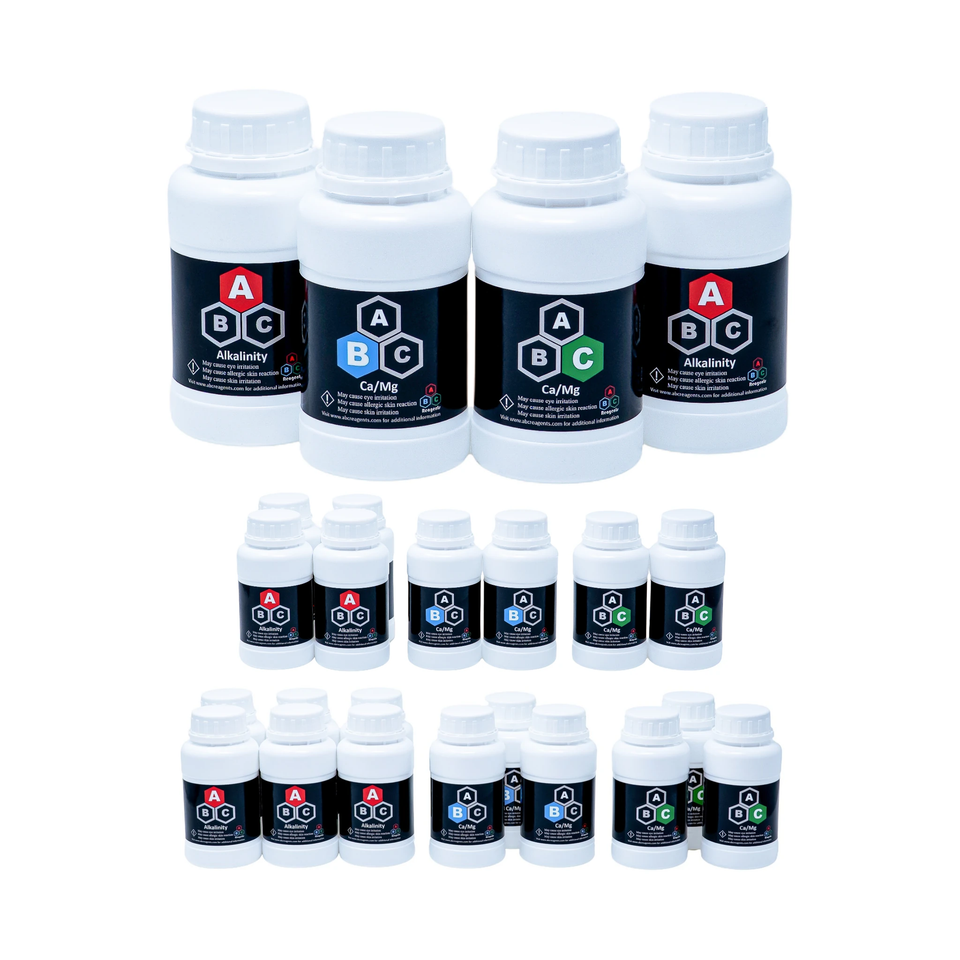
ABC reagents let an automated tester measure alkalinity, calcium and magnesium in a reef aquarium. Ours work with automated water testing systems and arrive pre mixed, so they go straight into the reagent bottles you already own.
That is what makes switching simple. You do not need new bottles, and you do not mix anything yourself. You change what is inside the bottles you already have. The kits come in 3 sizes, covering 2, 4 or 6 months of testing.
Some reef keepers prefer to mix their own, and we have nothing against that. Pre mixed suits people who would rather spend the time on the tank.
Alkalinity, calcium and magnesium are the 3 numbers many reef keepers watch most closely, and an automated tester checks them on a schedule. The reagents are the consumable behind those tests, which is why a switch needs a little care.

Before you switch
Choose the kit by how long you want it to last, and read the safety data sheets before you handle anything. Each kit is made up of 250ml bottles of reagents A, B and C.
| Kit | Reagent A | Reagent B | Reagent C |
|---|---|---|---|
| 2 month | 2 bottles, 0.5 L | 1 bottle, 0.25 L | 1 bottle, 0.25 L |
| 4 month | 4 bottles, 1.0 L | 2 bottles, 0.5 L | 2 bottles, 0.5 L |
| 6 month | 6 bottles, 1.5 L | 3 bottles, 0.75 L | 3 bottles, 0.75 L |
The month counts assume typical testing frequencies on automated systems, so your own usage may differ. Treat them as a guide rather than a promise. If you test more often than usual, a kit will go sooner, so a 6 month kit may not last as long as the label suggests. Think about how often your system runs before you choose.
Our UK safety data sheets are being reviewed and updated. Reagent C is on our safety data sheets page, and A and B are available on request from info@marine-spec.co.uk. Background on the reagents is at abcreagents.com.
- Read the safety data sheets
- Pour
- CalibrateTank Water Method
- Judge readings
Fitting and calibrating
Calibrate your automated testing system every time the reagent changes: after you first install these, and again whenever the brand or the batch is different.
The reason is practical. Formulations differ between brands, and batches of the same brand carry normal tolerances. Either can nudge results, so skip the calibration and your readings may not match what you were used to. A reading that has moved because of the reagent could look like a change in the tank, and you might act on it.
For the loading steps, follow the instructions for your own tester. We do not publish a loading routine of our own.
Pick a time when you can see the switch through, because calibration needs your attention and a skipped step is hard to spot afterwards. In outline, the order is:
- Read the safety data sheets for reagents A, B and C.
- Pour the pre mixed reagents into your existing reagent bottles, following the instructions for your tester.
- Calibrate your automated testing system.
- Only then judge the readings or change anything in the tank.
The Tank Water Method
The Tank Water Method gives the best accuracy. You calibrate against values from manual test kits you trust, so the machine agrees with readings you already believe.
The choice of manual kit matters. A calibration is only as good as the values you give it, so use kits you trust and take care over each test. If your manual results are doubtful, the calibration will carry that doubt forward.
Complete the calibration before you read anything into the results or alter anything in the tank. It is tempting to adjust dosing the moment a number looks odd. Wait until the calibration is complete, then look at the readings again.
Keep a note of the date, the batch and the manual values you used.
If a reading looks odd later, those notes show what you started from. Differences between batches are the reason you recalibrate, so the same note tells you when the next calibration is due: any time the batch changes.
If you are new to the method, abcreagents.com has more.
Where to find the reagents
The ABC reagents are listed with our dry goods, in 2, 4 and 6 month kits.
If you also dose live phytoplankton, our guides on live phytoplankton for corals and how much phytoplankton to dose cover the feeding side of the same routine.