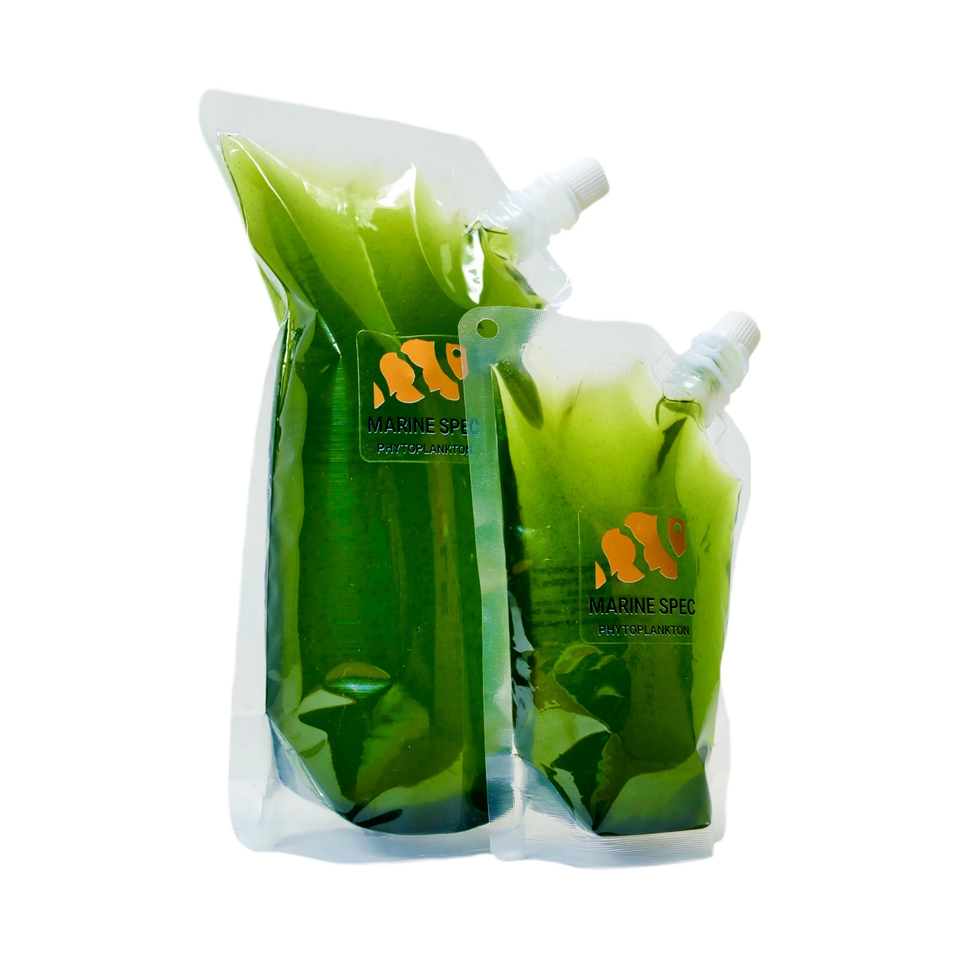

Live phytoplankton is easy to buy and harder to dose, because the right amount depends on your tank. This guide gives the starting figure from our own instructions, a table for bigger systems and the signs that tell you to change it.
Phytoplankton dosing by tank size
The table scales our 5ml per 45 litres starting dose in a straight line. If you know your net water volume, use it: the tank and sump together, minus the space taken by rock and sand. The sump counts because the dose mixes through the whole system, display included.
| Tank volume | Starting dose |
|---|---|
| 45 litres | 5ml |
| 90 litres | 10ml |
| 135 litres | 15ml |
| 180 litres | 20ml |
| 270 litres | 30ml |
| 450 litres | 50ml |
Only the 5ml per 45 litres figure comes from our own product instructions. The other rows are simple multiples of it, so for a big system start at the lower end of what you work out and build up.
At the starting rate, a 250ml size covers 50 doses for a 45 litre tank and a 500ml size covers 100. If your tank sits between 2 rows, take the smaller number and see how the water looks the next morning.
When to dose and what to switch off
Dose in the morning or evening, and switch off any UV steriliser or skimmer first. Both are built to remove tiny floating life from the water, and live phytoplankton is exactly that. If they keep running, a good part of the dose is stripped out before your corals and pods can use it.
- Give the bottle a gentle shake so the culture is mixed.
- Measure the dose from the table above.
- Switch off the UV steriliser and the skimmer.
- Add the dose, then put the bottle straight back in the fridge.
- Switch both back on afterwards.
Our instructions say to switch them off temporarily but give no time. Many reef keepers leave a skimmer off for a few hours after dosing, and the right time depends on your equipment, so follow the guidance for your own skimmer and UV.
Set a reminder on your phone if you tend to forget, because a skimmer left off for days is a bigger problem than a missed dose.
How to adjust the dose to your tank
Treat 5ml per 45 litres as the place to begin. Our instructions say to adjust the dose to the needs of your reef, which makes sense, because tanks differ in livestock, filtration, feeding and how quickly they clear small particles. Over the first week or two, look at 4 things.
- Water clarity the next morning. A faint tint that has cleared is normal. Water that is still noticeably green a day later suggests you can dose less.
- Coral polyps. Some reef keepers watch polyp extension after dosing as a rough sign that food is reaching the coral. It is a guide, not a measurement.
- Pods and filter feeders. A growing copepod population is one of the benefits we list for live phytoplankton, so more pods on the glass at night is encouraging.
- Nutrients. Phytoplankton takes up nitrate and phosphate as it grows. Test before you start and again after a couple of weeks, so you can see what changed in your own tank.
Change one thing at a time. If you alter feeding, skimmer settings and phytoplankton dose in the same week, you will not know which one made the difference. Make one change, wait a few days, then look again.
How often to dose
Our instructions give a starting amount and a time of day, not a schedule. Many reef keepers dose smaller amounts several times a week rather than one large dose, because it keeps the water clearer. Choose a pattern you can keep up and adjust by watching the tank.
Write the date and the amount on the bottle or in a phone note. After 3 weeks you will have a record to adjust from, instead of a guess. If you miss a day, go back to your usual amount the next time rather than doubling up.
The same habit helps if you run pods.
A steady small dose gives them food all week, where a single large one leaves them hungry once the water has cleared. It also makes it easier to spot a problem early, because the tank looks much the same from one day to the next.

Storing live phytoplankton
Refrigerate the bottle as soon as it arrives. Shake it gently each day so the culture does not settle. We recommend using it within 4 weeks of purchase, although it can last longer.
Our culture is grown in sterilised natural seawater sourced from the UK's leading supplier, so it should look dark and rich when it arrives. Take it out of the fridge only for the dose, then put it straight back. It comes in 250ml and 500ml sizes, and the smaller one is easier to get through inside the 4 weeks if you have a small system.
If the culture looks pale, or has clumped at the bottom of the container, give it a gentle shake and look again before you dose.
Fresh culture is dark and rich. If it still looks poor after a shake, or it is well past the 4 weeks, ask us before you put it in your tank.
What live phytoplankton does in a reef tank
It is food for the smallest things in your system. The benefits we list are reduced nitrates and phosphates, richer coral colour, faster coral growth and thriving copepod populations. They are not guaranteed, because every tank starts from a different place, and a table of doses cannot promise a result for yours.
Pods graze on the culture, which is why we feed our live marine copepods on it. If you are building a population, our guides on whether copepods need phytoplankton and how to grow copepods cover the next steps. For corals, is phytoplankton good for corals looks at what to expect.
You can buy live nannochloropsis phytoplankton from £5.99, and the rest of the range is in the live foods collection. If you want a hand with a dose for an unusual system, send us your tank size and what is in it.